


Speed outgrows hierarchy
Long approval chains cannot keep up. Teams need room to decide and act closer to the customer and the work.

The world keeps changing. Teams need to experiment, learn and adjust faster, without every answer or decision travelling upwards.
Self-organisation asks for different behaviour from everyone. Teams take ownership. People act and speak up. Leaders create clarity, space and boundaries instead of becoming the answer.
The challenge is that self-organisation doesn’t happen by design alone. You build the behaviour, step by step.
Sprinting alone stretches the elastic until it pulls you back.
Only the whole group actually covers ground.
The environment moves faster, work becomes less predictable and more decisions need to be made close to where the work actually happens.
Long approval chains cannot keep up. Teams need room to decide and act closer to the customer and the work.

More routine work gets automated. What remains asks for judgement, collaboration, difficult conversations and decisions under uncertainty.
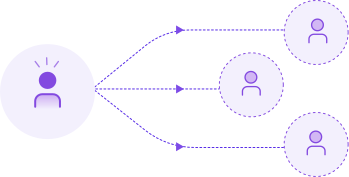
No manager can hold all the answers. Teams need to take responsibility, solve problems and learn without constantly looking upwards.
Not because the idea is wrong. But because it is often treated as a structural change, while the real shift is behavioural.
A few patterns show up again and again:
A layer disappears and responsibility moves down. But the behaviour, decision making and ownership needed to carry it often don’t move with it.
“Decide for yourselves” sounds empowering. Until nobody knows what they can decide, where the limits are and when to involve others.
Years of steering and solving don’t disappear with a new org chart. Under pressure, managers can slip back into micromanagement, get pulled into the urgency of the day, and start taking over again.
Self-organisation needs people to question, disagree, ask for help and admit mistakes. Without that, responsibility may move on paper, but not in practice.
Everyone is responsible usually means nobody quite knows who acts. Ownership needs to show up in decisions, actions, follow-through and reflection.
All five are behaviour problems. None of them is a
structure problem. That is why we start with
behaviour.
You don’t go from “the manager decides” to “the team owns it” overnight. Responsibility moves step by step, and not every topic needs to reach the same level.
For each topic, we make it concrete: where are we now, where do we want to be, and what does the next step ask from the team and the manager?
At every level, we practise the behaviour that belongs there: deciding, taking ownership, speaking up, reflecting and adjusting.
Not more freedom overnight. More responsibility, one step at a time.
The team decides within boundaries and owns the outcome
The team decides, the manager advises
We decide by consent, not consensus
The manager decides, the team is heard first
The manager decides and tells the team
Per subject, not everywhere at once. Most teams sit on three rungs at the same time.
Self organisation doesn’t just ask the team to take more ownership. The organisation, the manager and the team all have to move.
Set clear boundaries and give teams room to learn. Don’t pull responsibility back at the first mistake.
Move from decider to facilitator. Set boundaries, ask questions, stay available and resist taking over.
Decide, speak up, ask for help, reflect and own the outcome, not just the task.

Everything runs through one person

The team becomes the system
A self-organizing team is not a team without a leader.
It is a team with a leader who no longer sees
themselves as the solution.